Yuko Mohri will lead a workshop in Santander from June 1 to 10, 2026, titled Moré Moré (Leaky): Santander and organised by Fundación Botín. Participants will first explore Mohri’s exhibition Entanglements at Centro Botín, which entail an ad-hoc bricolage and the “Beauty of Use” (to borrow Japanese philosopher Soetsu Yanagi’s term). For Yuko, finding beauty —its aesthetic value and meaning— in everyday, functional objects lies at the root of the artistic process.
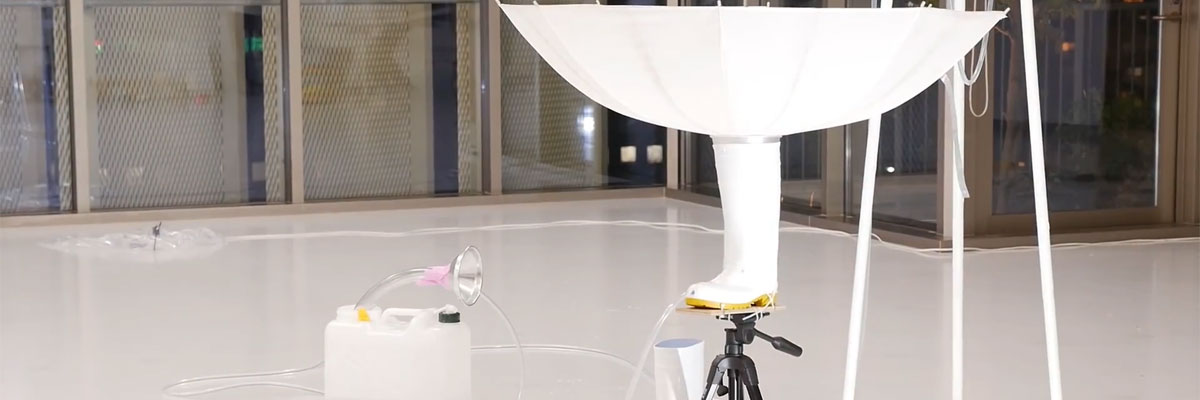
The artist began collecting photographic documentation of areas damaged by water leaks (“Leaky Spots”) in Tokyo subway stations as part of her fieldwork between 2009 and 2011. Station staff resort to everyday objects —such as buckets, tarps, adhesive tape, bottles and even plastic umbrellas— to deal with groundwater leaks in the urban infrastructure. This process of DIY bricolage has been incorporated by Mohri into her own artistic practice.
It was in this context that her well-known series Moré Moré (Leaky) emerged, which is included in the exhibition and which participants will explore together with the artist. This series forms the basis of the workshop, which will be complemented by conversations, participatory activities and collaborative work.
Yuko Mohri (Kanagawa, Japan, 1980), lives and works in Tokyo.
Mohri pursued an interdisciplinary course of study in fine arts at the Tokyo University of the Arts and her work has stood out from the very beginning for its connection to sound and music. She is also known for her intricate and original compositions and was recently selected to represent Japan at the 60th Venice Biennale (2024). Inspired by Marcel Duchamp (1887–1968) and Alexander Calder (1898–1976), Mohri creates site-specific kinetic sculptures that incorporate found items, as well as reworked musical instruments connected to electronic circuits. Her work responds to imperceptible, transient, and ephemeral phenomena, such as gravity, magnetism, heat, and humidity. Random and unstable environmental elements—such as air, dust, debris, and temperature—shape her assemblages, transforming them into organic ecosystems where the sound component is central.