CENTRO BOTÍN PRESENTS ITINERARIOS XXX, AN EXHIBITION THAT HAS SHOWCASED ARTISTIC CAREERS FOR 30 YEARS
- This show, which runs from 15 November 2025 to 19 April 2026, unites the proposals of the artists who were selected from the open call for the 2023 Fundación Botín Art Grants: Javier Bravo de Rueda, Noa and Lara Castro Lema, Diego Delas, Gelen Jeleton, Nader Koochaki and Eduardo Navarro.
- The projects presented assert art as a tool for the transmission of ancestral knowledge, gestures and beliefs, rescuing invisible histories as well as trades and mythologies that inhabit the margins of science and art.
- The Itinerarios exhibition is also celebrating its 30th anniversary. Thus, on Saturday the 15th, as well as opening its doors to the public, a series of round-table discussions will be held, featuring jury members and artists who have been part of Itinerarios’ long journey. The day’s event in Santander will bring together many of those who have received grants or taken part in the exhibition over its thirty-year history.
On 15 November, Centro Botín will present Itinerarios XXX, the annual exhibition that brings together and presents the works of the international artists who are awarded a Fundación Botín Art Grant. These grants have been awarded since 1993 to support artists in their training, research and production. This year’s edition commemorates thirty years of its existence. ‘This is a very special edition, as it marks three decades of unconditional support based on mutual trust between Fundación Botín and the artists. A continuity that allows us to accompany these artists’ vital and creative moments, supporting the maturation of art with the same disposition with which it was born’, notes Bárbara Rodríguez Muñoz, Director of Exhibitions and the Collection at Centro Botín.
So, on Saturday 15, to commemorate these 30 years of Itinerarios, we will hold a series of round-tables, spaces for intergenerational dialogue on the research and artistic production developed over these years. For this, current jurors and grantees will participate as panelists, as well as a large number of past artists and jurors, who will converge in Santander to share experiences and celebrate this shared history together.
Grants characterised by their openness and flexibility
Fundación Botín’s Art Grants are characterised by their openness and flexibility, since their rules set no age, nationality or subject limits, thus generating a broad space for exchange, experimentation and reflection across languages, contexts and generations. The annual Itinerarios exhibition marks the culmination of this process, where the ideas incubated during the grant period materialise in works that reveal the diversity and vitality of contemporary artistic practice. As Filipa Ramos, one of the authors of the essay in the publication accompanying this exhibition, points out, ‘Art grants provide a space where artists of different ages, backgrounds and origins can pause, review their practice and reinvent themselves’.
The six projects presented in Itinerarios XXX explore the relationship between nature, memory and non-rational forms of knowledge. From different perspectives, the projects engage in an affective and symbolic link with landscapes – marine, desert or floral – proposing modes of attention and contemplation which, often, question the hierarchies between the human and the non-human. Through this exhibition, the artists reclaim art as a tool for the transmission of ancestral knowledge, gestures and beliefs, rescuing invisible histories as well as trades and mythologies that inhabit the margins of science and art. Javier Bravo de Rueda interweaves archaeology, science fiction and ancestral cosmovisions in a small museum in Peru; Noa & Lara Castro Lema use video to transform their family’s memory of fishing into a musical tale about the sea, work and inheritance; Diego Delas‘ suspended structures evoke protective amulets that whisper voices that have disappeared from a pre-modern world; Gelen Jeleton uses the contemplative gesture of ‘seeing the flower’ to propose a pause in the face of productive time; Nader Koochak’ s timeline reconstructs a story where human gesture transforms the industrial landscape, while Eduardo Navarro proposes radical empathy with the non-human world, where art, affection and ocean merge in a single pulse.
It is worth highlighting the work of the jury, which has assembled a selection that reflects the breadth of artistic languages that defines the spirit of these grants and which, on this occasion, was made up of the curators Irene Aristizábal and Filipa Ramos, together with the artists Juan López and Jorge Satorre, both former art fellows of Fundación Botín.
Itinerarios XXX – Artists
Gelen Jeleton
Murcia, España, 1975
Political History of Flowers, Hanami (flower viewing), 2025
This installation is part of Gelen’s long-term project titled Political History of Flowers (2014-2025): a contemplative investigation into the symbolism of flowers, which proposes to stop activity in order to “see the flower”. During the fellowship, Gelen travelled to Japan to experience Hanami in parks and temples, as well as to examine its representations in museums, textiles and in everyday objects.
Hanami (花見, lit. “flower viewing”) in Japan is a social gathering to contemplate the cherry blossom. This installation, composed of drawings on tissue paper and a series of animations, depicts the sakura blossom (桜 Japanese cherry blossom) during hanami, the yozakura (夜桜, the cherry blossom at night night) and the hanafubuki (花吹雪, the shower of petals) and their memory. The drawings were made in the artist’s studio as an act of meditation and repetition, using petals as stamps and drawing frames in motion.
As the artist said, “I remember it was cold, rainy and windy, and we almost lost hope we would see the blossoms. In the end it happened: it was already the end of the trip and we were in the gardens of the Imperial Palace in Kyoto. All of us there turned our backs to the palace – so that we could see the flower”.
Javier Bravo de Rueda
Callao, Perú, 1989
They Saw Something in the Sky: Ufolotries and Desert, 2025
This installation, comprising a variety of different pieces, is based on Javier’s journey to discover the enigmatic Ica stones of the Museo Científico Dr. Cabrera (Peru), which are believed to be millions of years old. These stones tell stories of beings from other galaxies who coexist with giant creatures, alluding to the border between myth, science and speculation.
The exhibition hall takes us to this small museum in Ica, Peru, a place filled with suspicion and awe, where official history and alternative narratives confront one another. As the chronicler Agustín de Zárate wrote in the 16th century, the god Kon, “son of the sun”, walked without bones or joints, stretching out the earth beneath his steps. Inspired by this image, the project travels through deserts, fossils and ephemeral architectures to inhabit uncertainty and mystery.
The montage combines records, artefacts, animation, murals, sculptures and sound. It does not offer answers: it invites us to speculate, to lose ourselves between travel chronicles, science fiction and ancestral tales that speak of uncertain origins and sky-borne presences.
As the artist said, “The desert, here, is the protagonist and silent narrator. Walking, observing and listening become acts of creation. The exhibition proposes inhabiting doubt and making wonder a method for thinking about landscape, memory and the unknown”.
Noa & Lara Castro Lema
A Coruña, España, 1998
Cen pequenos soles, 2025 (A Hundred Little Suns). Video. 28’ 14”
For the making of this video, and the stories and performances presented in it, the artists have focused on the sea and the relationship that their family has had for generations with fishing activity, both on the high seas and along the coast.
Through stories collected and invented with their grandparents from the Costa da Morte, the artists have produced a musical tale that takes as its starting point the Gran Sol, a fishing ground in the North Atlantic, where their grandfather, Nelson, spent most of his life working.
This kind of fishing ground was originally called Grande Sole in French, meaning “great sole”. The phonetic translation into Galician from French connects two things, through language, that are in principle very far apart: fish (sole) and celestial bodies (sol), generating a performative game for the artists. In the video, this game is played out by hybrid characters in a loop where the past and the future come together in the present.
As the artists said, “Cen pequenos soles departs from life and memory, and from how the human and the non-human are connected through violence, care, work and death”.
Diego Delas
Aranda de Duero, España, 1983
Speak, Memory, 2025
Diego’s work explores the intersections and similarities between artistic practice and so-called popular art, following a personal obsession with the narratives and cosmovisions present in the arts and crafts, in the world of labour, and in the domestic.
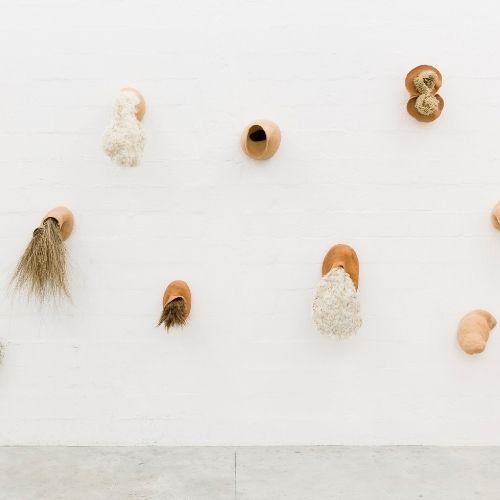
In this room we find a collection of big shapes arranged like collaradas – the clusters of amulets and talismans that were once used to protect children and infants – that divide and define the space. These pieces lie at the crossroads between arts and crafts, goldsmithing and decorum, and make us question whether the different pieces are related.
The work alludes to the pre-modern world, with talismans that can bring work or good fortune, where an ornament is understood as an idea of dignity, beauty and joy. These adorned works seem to portray vanished voices, taking us into the world of the strange, one that seems familiar, but is unknown.
As the artist said, “At a time when our presence in the world seems, to some extent, uncertain, we imagine objects once commonplace but of artistic—perhaps devotional—origin, the product of an obsessive yet hopeful endeavour”.
Nader Koochaki
San Sebastián, España, 1983
Las Simas, 2025
Nader Koochaki has carried out three investigations over the past twelve years in the territory of León. In 2013, he documented the traces of sabotage left by the most recent mining protests along
the transport routes. In 2018, he sought out and photographed waste dumps by using the National Inventory of Tailings Ponds and Waste Dumps (1972-1989). His insights help to construct a different account of mining than the one we are familiar with.
During the grant period, Nader has worked along a third line of research, gathering information on the life and work of Salvador Robles Aibar (La Iruela, 1957 – Santa Lucía de Gordón, 2009), a bulldozer operator who installed unusual rock assemblages across restored areas of the Corta Pastora. This project questions the possible intention of that operator and the presence of the rocks within a human-generated landscape.
In this room a collection of materials traces a timeline that relates to three questions: Are the stones, as some explain, shelters for animals? Can they be read from the perspective of art when the person who placed them had no link to this discipline? Can concepts such as marginal art or land art reinforce their importance, or on the contrary, would it give them a disproportionate significance for an action that was perhaps made without intentionality?
As the artist said, “It’s only possible to track agents and trace relationships. Cardinal points no longer help, stratigraphy no longer shows an order. The machine and the fossil are interconnected. From the heaviness of asphalt to the lightness of a pellet, the line becomes a cloud of dots”.
EDUARDO NAVARRO
Buenos Aires, Argentina, 1979
F.O.C.A, 2025
Eduardo Navarro explores ways of understanding the non-human world from the heart — or epicentre — of different entities, beings, and landscapes, where our relationship always seems to be mediated by human language and its limitations. The artist invokes a nonrational understanding of the world through individual and collective transformations that call for a new intuition and belief system.
F.O.C.A. (Foundation for the Oceanic Contemplation of Affection) is the project that Eduardo has developed over the last two years in Uruguay. Acting as a parental-mother, the artist dedicated himself to bottle-feeding orphaned sea lion pups, rescued by the SOS Marine Fauna Rescue shelter, located in Punta Colorada, Uruguay, where the artist currently resides. Simultaneously, F.O.C.A. is an official foundation whose mission is to invite artists to create works of art from the inner perception of what it means to become an oceanic entity.
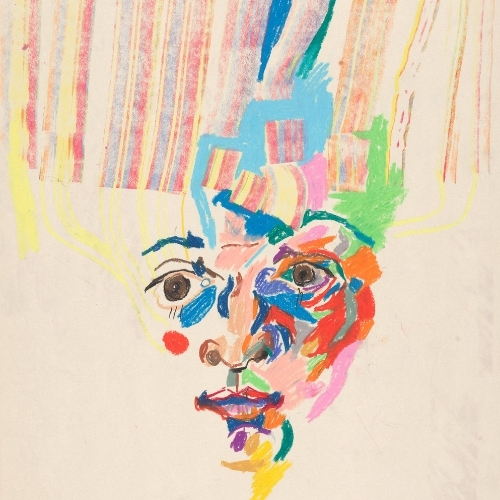
The video presented here documents his encounter with the sea lions with the goal of supplying the ocean with something that these pups lack, thereby acting as an emotional bond. The drawings were created by exploring the physical motricity of a sea lion, capturing a field of expression that refers to unconscious symbols, immersed in the depths of an ocean and its dreams. The text presented is a commission from Fundación F.O.C.A, which begins with a collaboration with the ecophilosopher Michael Marder.
As the artist said, “The costume in the exhibition is a vehicle, it helps me physically and emotionally to perceive the world from the place of a mother feeding her offspring. I believe that in this way, I return an anecdote to the sea. They know it’s a game, so they play it with complicity”.
Fundación Botín Art Grants
The Itinerarios exhibition cycle is the result of the work carried out by the artists during the period they enjoy Fundación Botín’s Art Grants. Year after year, their research is reflected in a catalogue that showcases their respective projects. In this edition, the catalogue essay was written by Filipa Ramos, curator and researcher, who was also a member of the jury.
This Grants programme fosters the training, research and development of projects by international creators. Since its inception in 1993, it has served to discover and support the careers of more than 200 artists, some of whom are already enjoying great recognition.
—
Photo caption:
From left to right (top row): Gelen Jeleton, Lara Castro Lema, Begoña Guerrica-Echevarría, directora del departamento de Arte del Centro Botín, Noa Castro Lema, Fátima Sánchez, directora ejecutiva del Centro Botín, Bárbara Rodríguez Muñoz, directora de exposiciones y de la colección del Centro Botín, Eduardo Navarro y Javier Bravo de Rueda.
From left to right (bottom row): Nader Koochaki y Diego Delas.
Photo credit: Belén de Benito.