CENTRO BOTÍN TO PRESENT THE FIRST RETROSPECTIVE OF MARISOL’S DRAWINGS
- A central figure of the New York art scene in the 1960s, the artist achieved early visibility—even before Andy Warhol—with her work featuring in Life, Glamour, and The New York Times, as well as presented at major international exhibitions such as the Venice Biennale and documenta 4 in 1968.
- Although it was sculpture that brought her international recognition, drawing was the practice that accompanied her throughout her life, and this exhibition sets out to use it, for the first time, as a means to approach her work.
- Curated by Dr. Laura Vallés Vilchéz, the exhibition is co-produced by Fundación Botín and MAC/CCB—Museu de Arte Contemporâneo and Centro de Arquitetura / Centro Cultural de Belém, Lisbon. It is the result of a collaboration with the Buffalo AKG Art Museum.
- As part of Fundación Botín’s commitment to curatorial and academic research into drawing practices, the exhibition features over one hundred works on paper, alongside a carefully selected choice of sculptures, films, and archival materials that trace the artist’s concerns, social reflections, and imaginative fictions.
- The exhibition will be accompanied by a publication, co-published with La Fábrica and designed by Filiep Tacq, including texts by Venezuelan British art historian and curator Cecilia Fajardo-Hill; Mexican researcher and curator Helena Lugo; and art historian Helena Vilalta, as well as an essay by the curator revealing the emancipatory potential of Marisol’s drawn work.
From May 23 to October 25, 2026, the Centro Botín will present Marisol: When Things Are Just Beginning, the first retrospective devoted to Marisol’s drawings. The exhibition brings together her works on paper from 1949 until the end of her life, contextualized alongside a selection of sculptures, prints, photographs, films, and documents drawn largely from the collection of the Buffalo AKG Art Museum—an ambitious selection that reveals how her work circulated publicly.
Marisol Escobar (Paris, 1930 — New York, 2016), known simply as Marisol, was a central figure in the New York art scene of the 1960s. Her sculptures—life-size wooden figures, portraits of public figures, and domestic and social scenes—placed her at the center of a visual culture that was beginning to think about art in relation to media, politics, and everyday life.
Born into a Venezuelan family and educated in Caracas, Los Angeles, and New York, her work was shaped from the outset by displacement between languages, contexts, and identities. Marisol achieved early visibility—even before Andy Warhol—with her work featured in Life, Glamour, and The New York Times, as well as shown at major international exhibitions such as the Venice Biennale and documenta 4 in 1968.
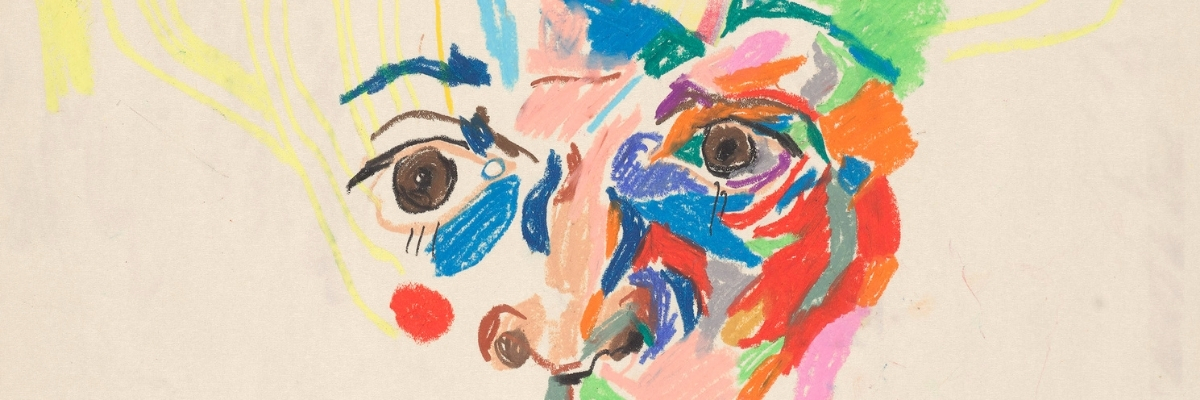
Although it was sculpture that brought her international recognition, drawing was the practice that accompanied her throughout her life, and this exhibition sets out to use it, for the first time, as a lens through which to approach her work. More than a preparatory medium, drawing was for her a space to observe, repeat, and question. Over the course of five decades, Marisol used her own face, worked with molds of the body, turned hands and profiles into repeatable signs, and explored the relationship between portraiture, the archive, and the public stage. In her drawings, identity appears as a shifting image: at times a face, at times a mask, at times a trace, and at times a shared scene.
This exhibition does not follow a linear trajectory; it is organized in three movements, evoked in the exhibition’s title, through which Marisol chooses to “escape” the art world. First, confronted with the speed at which fame arrives—following her first solo exhibition and at a moment of growing public recognition—Marisol leaves for Europe, beginning the first of these displacements. Her gallerist Leo Castelli wrote to her at the time, surprised: “How can you leave when things are just beginning?” Then, as the violence of the Vietnam War becomes increasingly visible, Marisol decides to travel to Southeast Asia, interrupting her presence on the art scene at a moment of peak visibility. Finally, another form of escape occurs when Alzheimer’s disease alters the relationship between will and memory, while drawing remains.
Exhibition Walkthrough
The exhibition begins with a film shot by Andy Warhol, from the collection of the The Andy Warhol Museum, showing Marisol in New York in the early 1960s, at a moment when her work was beginning to attract significant public attention. Warhol, with whom she formed a close friendship in 1962, filmed her alongside her sculpture Women and Dog (1963–64), now in the collection of the Whitney Museum of American Art. In the film, the artist remains almost completely still for several minutes, positioned at the same scale as the carved wooden figures.
Gallery 1
Marisol spent her childhood between Caracas and the United States before settling in Los Angeles in 1946. During these years—marked by displacement and the early loss of her mother—drawing became a constant practice and a space for quiet observation.
During her education and training in Catholic schools and art academies—such as the Otis Art Institute and the Jepson Art Institute—she learned to copy images with precision and patience. Soon after, as the illustrator of her school yearbook at the Westlake School for Girls—included in this area—she began to draw not only the people around her, but also the social structures that shaped her environment. At the center of this space is a sketchbook made between 1958 and 1960, which Marisol kept in her studio her entire life. In these drawings, female figures are duplicated, aligned, or transformed into blocks of color accompanied by short phrases.
Gallery 2
In the mid-1950s, Marisol’s work began to appear in the New York art scene. This section brings together drawings from those years alongside a key work from the period: Triumph (1959), a vertical structure of overlapping acrobatic figures in a seemingly precarious balancing act. The drawings on display, carried out in pencil, pen, or graphite during her studies at institutions such as the Art Students League or within the orbit of Hans Hofmann, reveal a sustained interest in human presence. Profiles, hands, torsos, and faces appear in compositions where the body starts to work as a satirical ensemble of shifting portraits. Also on view is Untitled (1960), from the collection of the Museum of Modern Art, New York, in which a multitude of shapes emerge, transform, and intermingle.
At the center of the space, tools and archival materials document the moment when her work began to circulate publicly: photographs, press articles, and the poster for her first solo exhibition at the Leo Castelli Gallery in 1957. It was precisely then, as her reputation was beginning to solidify, that Marisol chose to leave for Europe—in the summer of 1958—and her gallerist wrote her a letter with the phrase that gives the exhibition its title: “How can you leave when things are just beginning?”
Gallery 3
In the 1960s, upon her return from Europe, Marisol’s image began to circulate widely within the New York art scene. Her exhibitions at the Stable Gallery placed her at the center of the visual culture of the time, while magazines such as Life, Vogue, and Look published photographs of the artist alongside her sculptures, extending her presence beyond the museum space. During these same years, she developed a close friendship with Andy Warhol. The films shown in this space—drawn from the Andy Warhol Museum’s collection—offer insight into a shared moment of experimentation around portraiture and the public construction of image.
During this period, she also began incorporating molds of her own face and hands in her sculptures. One example of this is the bronze study for Mi mamá y yo (1968), a sculpture she kept her whole life. The use of the mold introduced a new condition: the body could be repeated and reorganized within a single image. This is the context in which Indian (1969) is presented—a sculpture that incorporates her own face into an image associated with the commercial iconography of the so-called “cigar store Indian,” traditionally found at the entrance of tobacco stores in the United States. The work raises questions about stereotyping and the limits of representation.
In 1968, in a moment marked by the protests against the Vietnam War, Indigenous activism, and the civil rights movement in the United States, Marisol chose to travel to Southeast Asia, interrupting for the second time her presence in the art scene at a moment of peak visibility.
Gallery 4
In the early 1970s, following her travels through Southeast Asia and Polynesia, Marisol’s drawings underwent a visible transformation. Color became more intense, contrasts sharpened, and words appeared more clearly within the images. This shift coincided with a period of profound social and political change: protests against the Vietnam War, civil rights movements, and feminist debates that challenged forms of representation and power relations in everyday life.
In the drawings presented in this space, the image is activated: hands reaching out, mouths speaking, weapons intruding, words intervening. A highlight is Get Away from My Fish (1975), a drawing included in the exhibition that Marisol presented at the Sidney Janis Gallery, in which a figure rides a gigantic fish while shouting the phrase that gives the work its title. Balancing humor and defiance, the scene can be read as an assertion of independence in the face of expectations surrounding her work.
This gallery also brings together works that continue one of the most complex aspects of Marisol’s practice: her relationship to historical images of Indigenous peoples within Western visual culture. In pieces such as Chief Joseph (ca. 1974–1980) and Cultural Head (1973), the head appears simultaneously as portrait and as a historically reproduced image. In the sculpture Woman with Child and Two Lambs (1995), Marisol takes up a photograph by the artist Laura Gilpin, displacing the ethnographic image towards a contained and material sculptural presence. The work is part of a body of work Marisol produced after her participation in the Expo ’92, where she met a delegation of Native American representatives, invited in the context of the quincentenary of 1492.
Gallery 5
The prints brought together in this space show hands, limbs, and fragments of the body interwoven with plant-like, organic shapes. This shift occurs at the same time as Marisol intensifies her work in the field of printmaking. From the mid-1960s onward, her collaboration with the Universal Limited Art Editions (ULAE) workshop enabled her to explore printmaking as a medium grounded in repetition. In the series Sign Language (1961–1973), hands cease to be mere anatomical fragments and instead become gestures that refer to a system of sensemaking.
Beginning in the 1970s, the artist’s attention also spreads to the stage. Drawing is no longer used only to organize the surface of paper but rather begins to intervene in the movement of dancers, in costume design, and in the relationships between performers on stage. Her collaboration with choreographer Martha Graham on Ecuatorial (1978) reveals this shift.
Gallery 6
In the early 1970s, the ocean starts to occupy an important place in Marisol’s practice. Following her participation in the 1968 Venice Biennale, the artist set out on an extended journey through India and Thailand. Shortly after, she traveled to Tahiti where she learned to dive and began filming underwater. The 8 mm films made in the late 1970s capture fragments of these immersions: fish crossing the frame, areas of diffused light, and particles floating in the water.
At the same time, sculptures such as Triggerfish I (1970) and the drawings presented in this area show how these observations transform into shapes. There are fish, hybrid creatures, and amphibious bodies, stylized to the point of ambiguity: they may recall marine organisms, but also technical objects or mechanical devices. This emerging concern, at the intersection of nature and technology and characteristic of the period, is shaped both by scientific exploration of the ocean and by its strategic use during the Cold War, as well as by the expansion of new underwater observation technologies.
Gallery 7
Timeline Marisol (1930–2016) – Annex
Gallery 8
Toward the end of her life, Marisol’s practice shifts in rhythm. Alzheimer’s disease alters memory and language but does not interrupt drawing. In her late works, carried out during the final years of her life, between 2006 and 2016, the line remains a way of not ceasing to observe and keep making images. The pencil portrait of an individual who may be her caregiver, made in 2006, introduces an intimate presence that quietly accompanies the end of the exhibition. After heroes, masks, public figures, and monuments, what emerges is a presence tied to everyday life and shared care.
At the beginning of this space, Self-Portrait with Hair (1981) brings the exhibition back to one of the recurring motifs in Marisol’s work: the face as a shifting image. If throughout the exhibit her work explored identity as mask, trace, or public representation, in these final works the question shifts elsewhere: how to keep drawing when memory becomes fragile.
Annex – Gallery 7: Timeline Marisol (1930–2016)
1930 — Born into a Venezuelan family in Paris as María Sol Escobar.
1935 — The family returns to Venezuela and alternates stays between Caracas and the United States. Marisol begins drawing in early childhood, a practice that will accompany her throughout her life. During these years she encounters American comic books and illustrated Mexican publications. She also visits the artist Armando Reverón in Macuto with her mother.
1940–41 — Studies at Foxwood School (New York) and at San José de Tarbes School (Caracas).
1941 — Her mother’s suicide has a profound effect on her life; from that moment, she barely spoke for several years.
1945 — Begins signing her work as Marisol Escobar; later she will use only “Marisol.”
1946 — Moves with her family to Los Angeles and studies drawing at the Otis Art Institute and the Jepson Art Institute.
1948 — Produces watercolors and illustrations for the yearbook at Westlake School for Girls.
1949 — Travels to Paris and studies at the École des Beaux-Arts and the Académie Julian.
1950 — Settles in New York.
1951–54 — Studies at the Art Students League, Hans Hofmann School, Brooklyn Museum School, and the New School for Social Research. During these years she comes across pre-Columbian sculpture, which will have a lasting influence on her approach to form, as well as debates concerning Surrealism.
1955 — Produces The Hungarians, one of her first sculptures incorporating found objects.
1957 — First solo exhibition at the Leo Castelli Gallery (New York).
1958–60 — Produces a sketchbook of drawings that she keeps in her studio for decades.
1958 — Appears in Life magazine. Shortly afterward she travels to Rome.
1960 — Returns to New York following her stay in Europe.
Early 1960s — Produces works such as The Generals, The Family, The Kennedy Family, Mona Lisa, and The Party.
1961 — Participates in The Art of Assemblage (MoMA).
1962 — Meets Andy Warhol.
1963 — Participates in Americans 1963 (MoMA).
1964 — Begins working with Universal Limited Art Editions (ULAE).
1968 — Represents Venezuela at the Venice Biennale and participates in documenta 4 (Kassel).
1968–69 — Travels throughout India and Thailand.
1970–72 — Produces lithographs and prints linked to her travels through Asia and the Pacific.
1972 — Monument to Simón Bolívar in Caracas.
1973 — Exhibition Marisol Prints 1961–1973 (New York Cultural Center; later at Espacio Actual, Caracas).
1975 — Exhibition at Sidney Janis Gallery featuring self-portrait sculptures and large-scale drawings. During this decade she collaborates with choreographers such as Louis Falco and Martha Graham.
1981 — Exhibition Artists & Artistes by Marisol (Sidney Janis Gallery). That same year she sits for a portrait by Alice Neel.
1983 — Receives Venezuela’s National Prize for Visual Arts. Writes her “Statement of Drawing.”
1984 — Presents Self-Portrait Looking at the Last Supper (1982–84). Designs stage sets for Elisa Monte.
1985–88 — Receives the Excellence in Design award (New York) and an honorary doctorate from the Rhode Island School of Design.
1987 — Creates Boy with Empty Bowl.
1989 — Exhibition at Sidney Janis Gallery dedicated to Latin American families.
1991 — Exhibition Magical Mixtures: Marisol Portrait Sculpture (National Portrait Gallery). Also produces the American Merchant Mariners’ Memorial.
1992 — Participates in the Seville World’s Fair; begins a series based on historical photographs of Native Americans.
1995 — Major retrospective at the Hakone Open-Air Museum (Japan).
1998 — Final solo exhibition at Marlborough Gallery.
2006–13 — Continues drawing after being diagnosed with Alzheimer’s disease.
2014 — The Memphis Brooks Museum of Art organizes the largest exhibition of her work to date.
2016 — Dies in New York on April 30. She bequeaths her archive, library, works, and apartment to the Buffalo AKG Art Museum.