CENTRO BOTÍN TO PRESENT THE FIRST EXHIBITION IN SPAIN OF WORK BY BRAZILIAN ARTIST SOLANGE PESSOA
- This exhibition will present a selection of works that connect Pessoa’s early research and work from the 1990s with ambitious formal developments of those same investigations in the present decade, including two bespoke installations created specifically for the architecture and setting of Centro Botín.
- Curated by Bárbara Rodríguez Muñoz, Director of Exhibitions and the Collection at Centro Botín, the exhibition’s title—Of Day or Night—refers to Pessoa’s universe, where opposites do not operate as fixed categories but instead generate a space of ambiguity in which opacity and brightness, the corporeal and the transcendent, the sacred and the profane, the dream state and wakefulness overlap.
- The exhibition will be accompanied by a publication featuring texts by Maria Berbara, PhD in Art History and a researcher specializing in art history and visual culture, and Ángel Calvo Ulloa, Spanish curator and writer, as well as a contribution by the curator. In addition, Pessoa will lead Fundación Botín’s next art workshop in Santander from September 21 to 29.
On October 10, Of Day or Night, the first exhibition in Spain dedicated to Solange Pessoa (Ferros, Brazil, 1961), will open to the public. The exhibition will be on view through March 28, 2027, on the second floor of Centro Botín. The Brazilian artist is internationally recognized for her multidisciplinary practice, encompassing sculpture, painting, video, performance, installation, and drawing.
Since the 1980s, her work has focused on themes connected to nature, memory, the body, spirituality, and the cycles of life. Pessoa occupies a singular place within contemporary Brazilian art, weaving together a range of local references such as Brazilian modernism, colonial Baroque, and Indigenous cosmologies with influences from Land Art, Arte Povera, Surrealism, and prehistoric symbolism.
Her work has deep roots in the landscape and context of Minas Gerais, a region of extraordinary natural wealth that has historically been one of Brazil’s key mining centers, rich in deposits of gold, iron, manganese, and other minerals and stones. The region is home to remarkable biodiversity, with numerous rivers and fertile lands, as well as a dense cultural heritage tightly intertwined with its colonial history, particularly notable in the art and architecture of the period known as the Barroco Mineiro or Minas Baroque. Through the use of organic and mineral materials—both ephemeral and “noble”—the artist establishes a direct relationship with this land and culture, evoking processes of metamorphosis and an oneiric engagement with landscape and matter.
Curated by Bárbara Rodríguez Muñoz, Director of Exhibitions and the Collection at Centro Botín, this exhibition is Pessoa’s first in Spain. The exhibit brings together a selection of works that connect her early research and works from the 1990s with the ambitious formal developments of those same investigations in the present decade. The works come from the artist’s studio as well as institutional and private collections, in addition to two bespoke installations created specifically for the architecture and setting of Centro Botín. According to the curator, “one of the most fascinating aspects of Solange Pessoa’s work is the way the spiritual never appears separate from the physical but rather emerges from matter itself—from its textures, intensity, brightness, and opacity. This exhibition invites visitors into a universe where the corporeal and the transcendent, darkness and light, the human and the animal cease to function as opposites and merge in a sublime way.” Thus, the title refers to Pessoa’s universe, where opposites do not operate as fixed categories but instead generate a space of ambiguity and contemplation.
Pessoa’s practice can be understood in relation to the legacy of anthropophagy associated with Brazilian modernism, insofar as it devours and transforms Indigenous, African, and European cosmologies into a language of its own. Pessoa’s work also harks back that of Aleijadinho, one of the leading artists of the Minas Baroque, known for his sculptures and architectural projects in Ouro Preto, the historic city renowned for its Baroque architecture and its role as a gold mining center.
As in the Baroque, her work is grounded in excess, material intensity, and contorted forms. In her case, however, that excess is visceral and organic; she uses hair, wax, leather, blood, and other organic materials, densely accumulated to create a powerful physical and sensory charge. Transcendence is central to her work, although it is not suggested through representation but generated through matter itself. Her works embody the shadows and the subconscious while simultaneously containing and revealing light. Materials transform, deteriorate, and enter into processes of continual change, evoking cycles of life and death. The exhibition thus brings together multiple temporalities, from ancestral impulses to traces that extend beyond the present.
The exhibition will be accompanied by a publication featuring texts by Maria Berbara, PhD in Art History and a researcher specializing in art history and visual culture with a focus on the Iberian world and Brazil, and Ángel Calvo Ulloa, Spanish curator and writer, as well as a contribution by the exhibition’s curator, Bárbara Rodríguez Muñoz, Director of Exhibitions and the Collection at Centro Botín. In addition, Solange Pessoa will lead Fundación Botín’s next art workshop, titled Gardens of Delirium, which will take place from September 21 to 29 as part of the foundation’s artistic support program.
Exhibition Tour
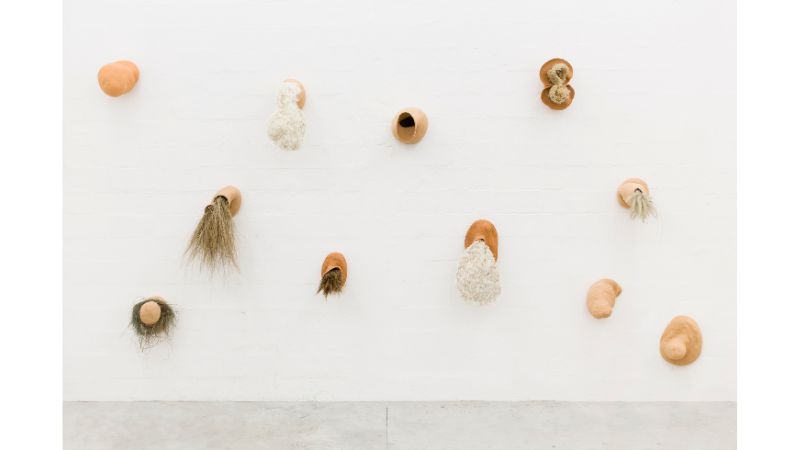
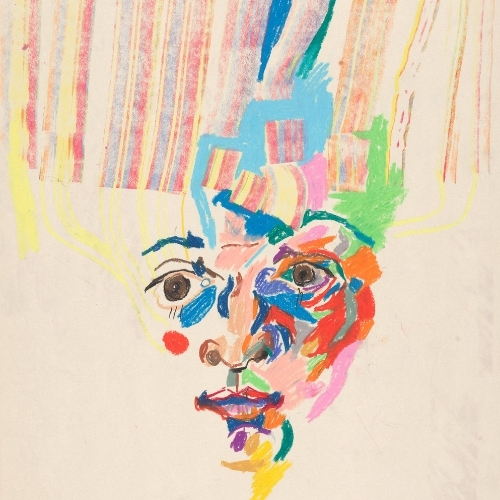
Visitors are welcomed by Hammocks (1999–2026), a group of suspended forms made from fabrics impregnated with earth and natural materials. The pieces suggest organs, shells, or remnants of a body fragmented in space. Facing them, Untitled (2011–2012) consists of a series of twelve vertical paintings made with earth on cotton curtains, which depict elongated anthropomorphic forms, nervous and skeletal systems, and animal and plant architectures reminiscent of prehistoric paintings. Together, these works form part of the artist’s investigation into the relationship between body, landscape, and matter, where the human and the geological become intertwined.
Delongas (2023) is a large-scale projection on a gallery wall in a darkened space, creating a visual, aural, and spatial experience. The video shows liquefied bronze in the process of solidifying, directing attention toward processes, states, and transformations, so that the melting and hardening of bronze become as significant as the resulting sculpture.
Catedral (1990–2003), one of Pessoa’s most intimate works, refers to the psychic structure of the subconscious. Developed between the early 1990s and 2003, it measures more than 330 feet in length and is made primarily of human hair, along with leather and fabric. Pessoa gathered the hair over many years—initially her own, that of family members, and friends, and later from hair salons—giving the work a deeply personal and emotional dimension. Pessoa has described how there are horses concealed within this work: the structure is suspended from the ceiling by leather equestrian accessories (rope halters and reins), allowing it always to touch the floor and unfold as a low, undulating line, close to the anatomy and movement of a horse, while also rising in a monumental and spiritual ascent suggestive of Oscar Niemeyer’s Cathedral of Brasília—a reference cited by the artist herself in relation to its curves and organization of space. The use of hair also links to the Baroque, where the material was incorporated into devotional objects, as well as to ritual practices of African origin such as Santería, in which bodily materials are understood as active substances within ceremonial practices.
Connected to the installation Catedral, Solange Pessoa’s performance Cornelius (2002–2011)—filmed in 2001 in the historic Baroque town of Congonhas do Campo—is periodically activated at Centro Botín. It consists of a hooded figure wandering slowly through the space as an ambiguous presence somewhere between human and animal. The hood, also made of human hair, envelops the performer, who moves almost blindly, activating a living sculpture that explores and inhabits the surroundings.
The exhibition includes two new and ambitious installations developed specifically for the architecture of Centro Botín, both of which convey that tension between opacity and brightness, materiality and transcendence, that characterizes Pessoa’s work. Arreios (2026) consists of seventeen spectral figures suspended from the gallery skylight, made from antique horse saddles hand-stitched with fragments of leather that hang like medieval garments. For the artist, horses evoke a medieval space within the colonial imagination and also represent mythical animals, used for both transportation and combat. The work stems from Pessoa’s experiments with horse saddles in the 1990s, finally realized for this exhibition in keeping with her desire to connect the territory of the Iberian Peninsula with her native region. In this way, the work engages with the Iberian legacy in Minas Gerais, marked by Spanish and Portuguese domination, where the horse was as a fundamental instrument in the expansion of colonialism.
This work shares the space with the performative video Cavalos (2003), which shows a group of horses grazing on a ranch in Minas Gerais with hoods made of human hair covering their heads. Together with the series of twenty-nine drawings De vez em quando os cavalos voltam (2003–2008), the video invokes the horse as a mythological figure and human’s unconscious relationship with the animal, in the sense of what is considered “wild.”
The exhibition concludes with Origo (2010–2026), also produced by Fundación Botín. Composed of a multitude of sculptures arranged on a ground of clay, bronze, and organic elements, the work features amorphous forms, irregular contours, curved volumes, and textured surfaces that connect it to ancestral and natural processes. The presence of mineral materials refers to the context of Minas Gerais and its extractive history, while the shine of bronze introduces an almost luminous quality that contrasts with the opacity of the earth, echoing the legacy of the Baroque. Situated overlooking Santander Bay and bathed in natural light, the work generates powerful effects of intensity and presence.
*In collaboration with Fondation Cartier, Paris